This is an old and dusty work. It has proven to be useful for many but it can't be used anymore as a production quality software... The main problem is that nothing has been done to adapt the source to the evolution of OS since 1993 :)
Algorithm animation is a powerful tool to explore a program's
behavior. It is used in various areas of computer science, such as
teaching, design and analysis of algorithms or performance tuning.
Algorithm animation systems provide a form of program visualization that
deals with dynamic graphical displays of program's operations.
They offer many facilities for users to view and interact
with an animated display of an algorithm, by giving various ways to control
the data given to algorithms and their execution through multiple views.
Zeus and
XTango are two well-known systems for doing
algorithm animation. However, they both share the same lack of
simplicity. The aim of this work was to design and implement a new
tool allowing rapid and easy production of algorithm animation.
This tool is called
agat (Another Graphical Animation Tool)
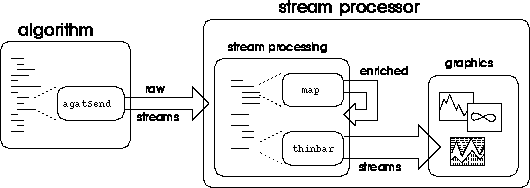
Agat provides support for watching a program in action,
through the use of a stream processor.
To animate a program you have to provide some of its output to the server by sending them on some named streams.
Streams can then be combined to form more streams. The output of a stream can be
linked to the input of a graphical operator to produce a display.
Whenever an interesting value is sent on a stream by the program, the
value is propagated along all the combined streams, and each stream output
updates its visual display appropriately.
A very important feature of agat
is the client-server architecture it is based upon: the animation
server is a separate process. Only a few lines of code have to be added to
the source program in order to animate it and the animation itself is
described within an animation file to be loaded in the stream processor.
This architecture makes the description of the animation independent from
the program to be animated, thus eliminating the need to recompile the
program everytime you need to change the animation.
agat can save an animation and replay it at the speed you want. In
fact all the values are saved (with their time of arrival to keep a "real
time" feeling) so that you can easily try any other animation without having to run your program again.
According to the first experiences we made, algorithm animation
with agat is quite simple and powerful enough for most needs.
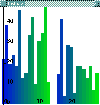
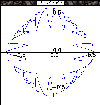
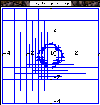
These pictures were built by adding one or two lines to source code and
writing a very short description of what must be plotted. Take a look at the
documentation to understand how this powerful tool may be adapted to your
needs.
Here is a list of examples with the C and Agat code and the result of the
execution for different graphical operators:
The first series of examples are very basic. They demonstrate that
agat is very simple to use and that you can obtain an interesting
animation with only a few changes in your source code.